
Pro-Ject Tube Box DS3 B Balanced Valve Phono Stage
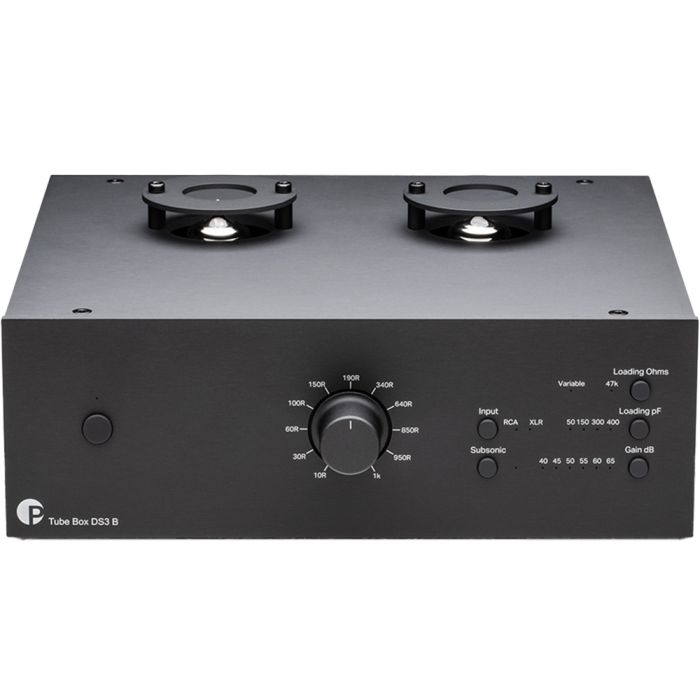

In stock




Features
| MC input | No |
|---|---|
| MM Input | No |
| Adjustable Gain | No |
| Brand Color | None |
| Adjustable Impedance | No |
| Warranty The length of time your product is protected by warranty | 2 Years |
| Product Type | Other |
Tech Specs
- Input Impedance (MM) - 47 kΩ
- Input Impedance (MC) - Variable 10 - 1,000Ω
- Phono Stage Capacitance (MM) - 50, 150, 300 or 400 pF
- Phono Stage Gain (MM) - 40, 45, 50 dB
- Phono Stage Gain (MC) - 50, 60, 65 dB
- Phono Stage Equalization Options - RIAA
- Subsonic Filter - at 20Hz with 18dB/octave
- RIAA Accuracy (20Hz - 20kHz) - ± 0.2 dB
- Valves - 2 x ECC83
- THD - < 0.04 %
- Signal To Noise Ratio (MM Input) - 88 dB
- RCA Input(s) - 1 Stereo Pair
- Balanced XLR Input(s) - 1 Stereo Pair
- Balanced Mini-XLR Input - 1
- Fixed Analogue Output(s) - 1 x RCA Pair, 1 x XLR Pair
- External Power Supply Rating - 18V-1000mA DC
- Maximum Power Consumption - 0.5 W
- Dimensions (W x H x D) - 206 x 91 x 227 mm
- Weight - 1.5 kg
Description
The Pro-Ject Tube Box DS3 B Balanced Valve Phono Stage is perhaps the ultimate phono preamp. It has everything you need for any type of modern cartridge. Moreover, it has a valve output stage for that warm valve sound. The dual mono design is balanced and has a good channel separation.
It is an upgrade from the Tube Box DS2. Features include input resistance, gain, and capacitance, there is also a subsonic filter. The output is provided by a couple of ECC83 valves and you can connect two turntables.
About cartridge types
There are two main cartridge types in use today. Moving magnet and moving coil. The Pro-Ject Tube Box DS3 B Balanced Valve Phono Stage can handle both with aplomb. Moving magnet types have a tiny magnet mounted to the end of the cantilever. The cantilever holds the stylus tip and the magnet sits in a coil.
Groove modulation moves the magnet and creates the audio signal. The signal level is 5mV or so and the input impedance is around 47K. Alternatively, moving coil cartridges have the coil mounted onto the cantilever. There are actually two coils one for each channel.
Moving coil cartridge properties
MC cartridges have a much lower output voltage and a wider range of output impedances. Hence the Pro-Ject Tube Box DS3 B Balanced Valve Phono Stage has a variable resistance setting as well as selectable capacitance.
Impedance is actually a combination of resistance, inductance, and capacitance and varies with frequency. Moreover, MC cartridges are inherently balanced and this preamp has balanced XLR inputs. There is also a special input for Pro-Ject True Balanced turntables.
About balanced systems
Balanced cables were first used in the studio for microphones. They use a different wiring arrangement to standard cables with a “hot” and “cold” signal wire as well as a common 0V reference. Hence three leads per channel.
Balanced systems reduce noise pickup and allow for longer cable runs. They work by having inverted signals on each wire, when these are recombined at the amplifier any noise is cancelled out, similar to 2-2 being zero.
Good connectivity.
The Pro-Ject Tube Box DS3 B Balanced Valve Phono Stage has two sets of inputs so that two turntables can be connected simultaneously. There are Balanced 3-pin XLR inputs as well as the standard RCA connectors. High-end features include settings for gain as well as a subsonic filter. The settings are stored in memory for each input.
Premium build quality
Only the best components are used in the Pro-Ject Tube Box DS3 B Balanced Valve Phono Stage. The metal case offers good shielding and an external power supply is used. A PSU upgrade is also available. The metal case removes any possible source of interference with the sensitive preamp circuits. Magnetically attached Wooden side panels can be added for a 1970s look.
ECC83 Valve output stage
The output stage of the Pro-Ject Tube Box DS3 B Balanced Valve Phono Stage uses two ECC 83 valves. These are dual triode devices with a high voltage gain. Valves are used as they provide a warm sound. Notably, valves have a heater that heats a cathode.
This then emits electrons in an evacuated glass bulb. Additionally, there is an anode that is kept at a high voltage. This attracts the electrons to create a current flow. The last element of a triode is the control grid. This is where the signal is applied via a DC-blocking capacitor. The grid is kept negative which controls the current flow and provides amplification via the anode circuit.