
Pro-Ject Evo 9 CA Carbon Tonearm
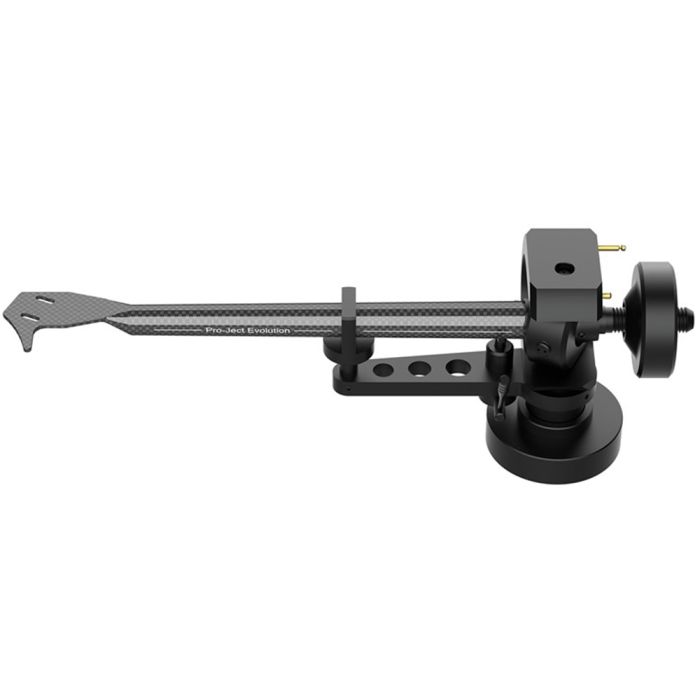

In stock




Features
| Brand Color | None |
|---|---|
| Warranty The length of time your product is protected by warranty | 2 Years |
| Product Type | Other |
Tech Specs
- Tonearm Type: Adjustable
- Tonearm Material: Carbon Fibre & Aluminium Sandwich
- Overhang: 18 mm
- Effective Tonearm Mass: 15.5 g
- Weight: 0.506 kg
- Effective Tonearm Length: 230 mm
- Tracking Force Range (with supplied counterweight): 0 - 3 g
Description
The Pro-Ject Evo 9 CA Carbon Tonearm is a standout option in the coveted Evolution range, renowned for its exceptional sound quality and reliability. Designed for audiophiles seeking flexibility in their setups, this 9" tonearm is an ideal upgrade for any turntable.
The EVO CA Premium tonearm showcases Pro-Ject's latest advancements, incorporating years of development and testing. It features a robust stainless steel bearing block, a solid inner tonearm bearing design, and high-purity silver inner wiring, all contributing to superior performance.
The tonearm boasts a sandwich construction of carbon and aluminum, which enhances resonance resistance while increasing effective mass, ensuring improved audio fidelity.
Design Highlights
The EVO 9 CA Premium is equipped with a carbon/aluminum tonearm tube featuring a conical shape, specifically designed to eliminate resonances and minimize moving mass. It utilizes inverted Swiss ABEC 7 quality stainless steel tips set in cardanic ball bearings, allowing the cartridge to extract even the most delicate musical details from the record groove.
This hybrid tonearm tube consists of a one-piece carbon fiber layer wrapped around an aluminum inner tube, resulting in slightly higher effective mass than the standard CC version, as well as improved damping and better electrical isolation.
EVO Technology
The EVO range offers a diverse selection, allowing you to find a tonearm that perfectly matches your cartridge's effective mass and material preferences. The EVO 9 CA Premium can be fine-tuned with various headshell materials to suit your audio needs.
Included with the tonearm are two damped stainless steel counterweights for precise adjustments, accommodating a wide range of cartridge weights. Additional counterweights are available for further customization.
With its combination of innovative design and premium materials, the EVO 9 CA Premium Tonearm stands out as an exceptional choice for audiophiles looking to enhance their listening experience. Experience the perfect blend of craftsmanship and performance with this remarkable 9" tonearm.
Customer Reviews
Pro-Ject as far as can see do not publish any geometric drawings of these tone arms so here is some information that may be relevant; the minimum distance from the bottom plane of the mounting flange to the underside of the headshell (arm horizontal) is approximately 65mm and the overall height is about 86mm. If the armlift is removed (disappointingly revealing an unpainted surface) both measurements can be reduced by approximately 3mm (there is no relief in the mounting ring to accommodate the bottom of the lift mechanism). This means even with a tall cartridge fitted e.g. Ortofon Quintet, the minimum height of the platter relative to the armboard/plinth the tonearm mounting flange is attached to needs to be approximately 43mm. For example, mounted on a Linn Sondek LP12 (more on this later) loaded with a 5mm acrylic platter mat still requires about 11mm of headshell spacers. Or about 8mm of spacers if you have a steady hand. And you can forget using the dust cover.
It is also worth noting that there are no instructions supplied only a drilling template. Arguably if you are looking at this it is you are probably not buying your first vinyl reproduction equipment and own a test record and the relevant alignment/measuring equipment.
The tonearm is very good audibly. Fitted with a Goldring Eroica LX, transferred from an early 2000’s Origin Live modified Rega RB250 (very similar design to the current RB880) that the Pro-Ject is replacing, there is an improvement in bass definition and leading edge of percussion/cymbals and the general sense of space between instruments is noticeable. Vocals are presented clearly and more to the front of the mix but not in an unpleasant way.
Here is where the tonearm loses a star. From the manufacturer; ‘Stainless steel counterweight sliding on a high precision thread on two TPE rings for damping’. Apart from the oxymoronic concept of ‘sliding on a high precision thread’ there is no sliding, gliding or even smooth turning to be had here. There is no actual female threaded counterpart in the counterweight to the thread on the rear stub. The TPE rings at front and back of the counterweight are the only contact with the threaded stub. They are 0.4mm smaller in diameter than the outer diameter of the thread and are set perpendicular to the stub. This results in a considerable interference fit and the counterweight twisting as the first ring tries to match the angle created by the pitch of the thread. It should be noted at this point that substantial force is required to achieve this initial part of mounting the counterweight. Once the counterweight is screwed on far enough to engage the second ring the thread wants again to orientate the perpendicular TPE ring to match the angle of the thread but is now unable to do so. This resistance is more than doubling the amount of force that was initially required to start mounting the counterweight. Even with a dab of suitable grease applied to the TPE rings there is still substantial resistance to movement. Initially the tracking force also exhibits a small amount of meandering as the two TPE rings pull in opposite directions reducing with the application of lubrication. The big issue here is that the only way to stop the substantial moment the stub experiences creating an equal torque directed into those advertised Swiss bearings perpendicular to the axis in which they are designed to function is to grip the carbon/aluminium arm tube and hope the azimuth adjustment grub screw holds (Machined flats or a slot at the end of the stub if you're listening Pro-Ject).
Also worth noting; no tonearm lead is supplied. The base of the tonearm accepts a 5-pin din plug (12mm). There are two counterweights supplied, and the lightest will allow the fitting of cartridges weighing 7g’s or more. This excludes a very large number of cartridges without adding weight to the headshell. Alternatively, the larger weight will allow fitting an Ortofon MC Diamond should you be on good terms with your bank manager or are the owner of a bank!
And finally, fitting the tonearm to the Linn LP12.
If you are considering this and baulk at the idea of applying power tools to the armboard, using headshell spacers, and/or thicker platter mats, repositioning dust cover hinges and doing without an armlift then you will be well advised to keep saving for the Krane or Arko.
It should also be said that mounting the Pro-Ject 9CC CA Evo on the LP12 is probably only possible if you have a current sub-chassis.
Simply put; Remove the armlift. Create a 64mm clearance hole in the armboard (or do without one) and attach the tonearm mounting flange directly onto the sub-chassis. Fit the tonearm seated as low as it will go. The downside, apart from the loss of the armlift, is the loss (presuming the armboard is still in play) of simple VTA adjustment (which is sort of inconsequential as the rear of the arm is still too high to be parallel with the vinyl surface without spacers) and the dustcover won’t close (repositioning the hinges to be flush with the top of the plinth creates enough clearance to enable continued use). I think it would also be possible to remove the arm rest support rail and mount the rest pillar directly to armboard (as the Ittok armrest was) which would allow the tonearm to be lowered by about another 7mm, but this would require considerably more work (and ideally access to machine tools).