
Pro-Ject Power Box RS2 Phono Power Supply

In stock




Features
| Brand Color | None |
|---|---|
| Warranty The length of time your product is protected by warranty | 2 Years |
| Product Type | Other |
Tech Specs
- Input voltage: AC 230V/50Hz IEC C15 connector (120V/60Hz US)
- Turntable Output: 15V / 2A (±0,5% ripple)
- Phono Stage Output: ±18V/2A (±0,5% ripple)
- Filtration capacity: 10.000 μF
- Dimensions W x H x D: 206 x 71 x 209 mm
- Weight: 3100 g
Description
The Pro-Ject Box RS2 Phono Power Supply is designed to work with Project turntables that run on 15V DC. The noise performance and stability of a power supply are important with high-gain circuits, such as those used in Phono preamps. There also needs to be a low ripple. As a result, Pro-ject has designed a premium PSU for their turntables and phono stages.
It will also power Pro-Jects phono preamp boxes that run on 18V DC. The reproduction of vinyl will have a whisper-quiet background and improved clarity.
Low noise Linear power supply
The Pro-Ject Box RS2 Phono Power Supply features a much larger toroidal transformer than usual for such units. Toroidal transformers have a lower magnetic field than conventional transformers. Additionally having extra capacity means that any load will not not cause an increase in ripple and noise.
Large reservoir capacitors
Reservoir capacitors are used to both remove ripple and to act as a power reserve for large transient loads. The Pro-Ject Box RS2 Phono Power Supply has a large filtration capacity. This provides a low-impedance output that can easily drive a turntable and phono box. The result is a silent background for vinyl playback, with an increase in clarity.
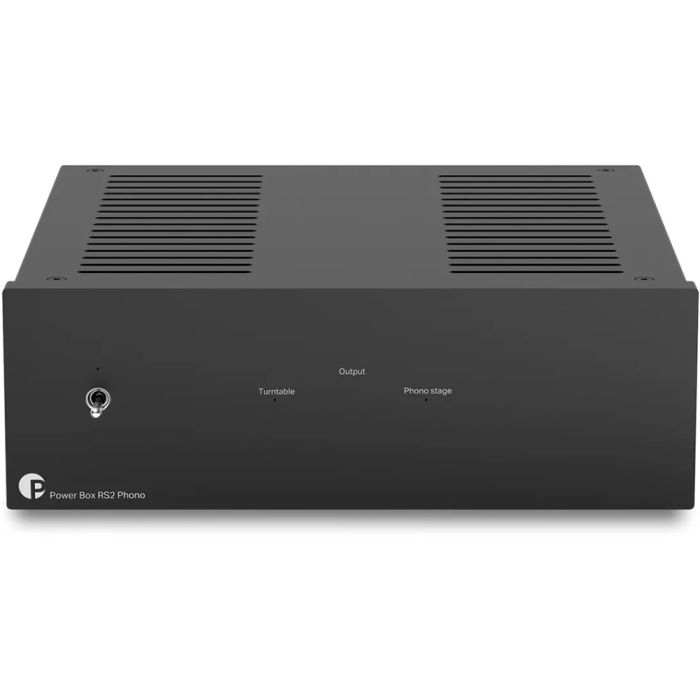
The front of the unit features two LED indicators that illuminate when the turntable and phono box are connected. The output uses three-pin sockets for the cables. Lastly, the unit also has a soft start circuit and surge protection.
About power supply types
Linear power supplies are recommended for improved noise performance. Some lesser power supplies use switch mode methodology. These are more efficient but can radiate radio frequency interference and other noise. This is due to the high-frequency switching employed. They also need to be heavily shielded to stop RFI from radiating into the environment.