
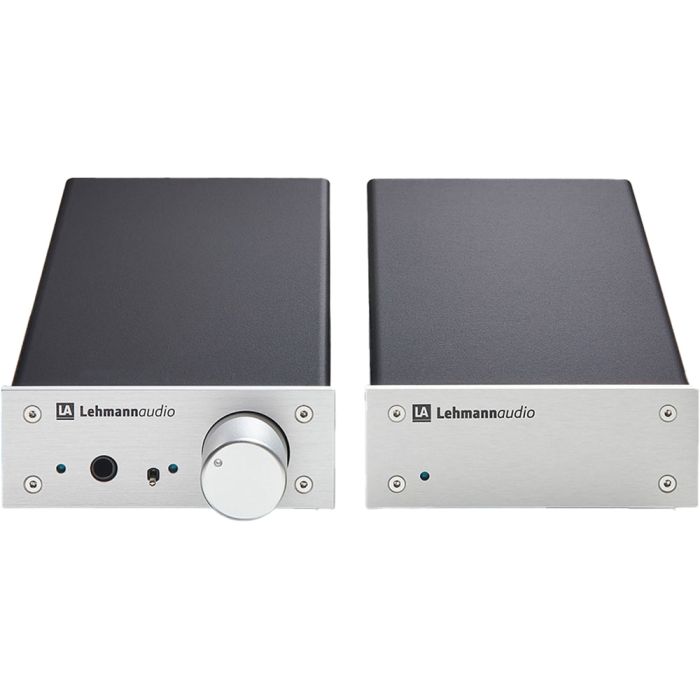
Lehmann Phonolith Phono Stage and Headphone Amplifier

In stock




Features
| Includes Pre Amp | No |
|---|---|
| Digital USB Input | No |
| Brand Color | None |
| Digital Optical Input | No |
| Digital Coaxial Input | No |
| Warranty The length of time your product is protected by warranty | 2 Years |
| Product Type | Other |
Tech Specs
Phono preamplifier -
- Input impedance - 7 kohms, 1 kohms, 390 ohms, 100 ohms and intermediate positions selectable via DIP switch, slot for selectable impedance
- Gain - 36 dB, 46 dB, 56 dB, 66 dB
- Bass filter - 7 Hz, 32 Hz, 50 Hz, 78 Hz selectable via DIP switches
- Channel separation - >70dB
High level -
- Input impedance - 47 kohms
- Maximum gain - 0dB, 10dB, 20 dB selectable via DIP switches
- Maximum output voltage - 9V eff.
- Output impedance pre out - 50 ohms
Headphone output
- Output power - 400 mW/60 ohms
- 200 mW/300 ohms
- Output impedance - 5 ohms
- Connectors audio - 1x Phono In stereo, RCA gold-plated GND
- 1x High Level In stereo, gold-plated RCA
- 1x Pre Out Stereo, gold-plated RCA
- 1x Neutrik stereo headphone jacks 6.3mm with gold plated contacts
- Mains voltage - 240 V AC
- Power consumption - 13 W
- Outer dimensions Audio W x D x H - 110 mm x 280 mm x 50 mm
- Outer dimensions power supply W x D x H - 110 mm x 280 mm x 50 mm
- Weight complete incl. connection cable - 2.8 kg
Description
The Lehmann Phonolith Phono Stage and Headphone Amplifier is a high-end phono preamp and reference-quality headphone amplifier. This two-box unit is compact and offers exceptional performance. The phono stage features multiple gain and impedance settings.
As a result, most current cartridges can be used. Moreover, the headphone output is one of the highest available. This will drive even insensitive headphones. Lastly, the units are fitted with 3S feet that are designed to absorb parasitic resonances.
Why a phono preamp?
Vinyl playback is becoming mainstream again and there is a need for a versatile phono preamp. The Lehmann Phonolith Phono Stage and Headphone Amplifier uses only the best components and the two-box form factor is designed to minimise interference. Moreover, the headphone amplifier is a balanced design that further reduces noise.
Multiple impedance and gain settings
The Lehmann Phonolith Phono Stage and Headphone Amplifier feature four impedance settings as well as four gain settings. This ensures that the most available Moving magnet and moving coil cartridges can be used. Additionally, four bass filter settings can be used to eliminate rumble.
Also, the phono stage performs playback equalization. Records are cut with reduced bass and boosted treble. This is known as the RIAA curve. The preamp reduces treble to improve noise performance and boosts the bass.
About cartridge types
There are two main cartridge types in use today. Moving magnet and moving coil. They both have different output levels and impedance requirements. For example, moving magnet cartridges have an output of around 5mV and an impedance of 47Kohms.
On the other hand, moving coil cartridges have a wider range of outputs. These can be below 1mV in some cases. Hence the Lehmann Phonolith Phono Stage and Headphone Amplifier has a range of different gain and impedance settings.
High-output headphone amplifier
The headphone amplifier with the Lehmann Phonolith Phono Stage and Headphone Amplifier has a high output that can drive even insensitive headphones. Lehman Audio is renowned for its headphone amplifiers and they are often used in recording studios.
Additionally, the output is balanced so that long cable runs do not introduce any noise. The unit can also be connected to an external amplifier or smart speakers.
Good connectivity
The phono preamp with the Lehmann Phonolith Phono Stage and Headphone Amplifier has RCA connectors for the turntable as well as line-in connectors. There is also a pre-out for connecting to an external amplifier. The headphone unit has a standard 6.3mm socket on the front and two balanced XLR outputs on the back.
About balanced leads
Balanced leads were developed for recording studios to reduce noise pickup on long cable runs. They use three wires for a mono signal and five for stereo. Each pair of wires has a hot side and a cold side. The signal on each wire is inverted or of opposite phase. At the headphone end of the cable the signal phase is reversed and this tends to cancel out any noise from the lead. Similar to how 2-2 = 0.